
Nationalization 2.0: Who Else Will Lose Property in Russia and the Occupied Territories to Benefit Putin’s Inner Circle
The seizure of assets has become not only a price paid for loyalty to the closest circle of the Russian dictator, but also a tool for compensating losses incurred during the war against Ukraine

Preamble
Nationalization in Russia is increasingly turning into an instrument for the redistribution of property and the mobilization of resources under wartime conditions. In 2025, the value of seized assets increased several times compared with the previous year, while the list of grounds for confiscation expanded. At the same time, actual budget revenues from privatization remain disproportionately low, indicating that the key purpose of this process is not fiscal effect but rather the establishment of control over assets and their redistribution among structures close to the authorities.
Meanwhile, the list of "untouchable" individuals and sectors is shrinking, and nationalization is moving to the regional level. This may indicate a significant reduction of the "feeding base," which will make it more difficult to compensate for wartime losses for the inner circle of Vladimir Putin.
As for the developments of the past year, most of them were expected: the expansion of sectors and legal grounds for nationalization, a reduction in the number of untouchable groups, the growing nationalization of foreign assets, and decentralization (with the process shifting to the regions and Rosimushchestvo paying particular attention to the newly occupied territories).
For the first time, nationalized assets are being transferred to the Ministry of Defense rather than to state corporations. This suggests that the worsening economic situation in Russia is forcing the authorities to compensate military losses through nationalization as well.
Context
In December 2025, the head of the Russian Union of Industrialists and Entrepreneurs once again appealed to Vladimir Putin to reconsider the nationalization process. Business leaders had already raised this issue with Putin in 2023; at that time he agreed to review it, but no decision was ultimately adopted. The nationalization of assets and their transfer to individuals close to the Russian president remains the only available mechanism for compensating the growing losses caused by the war.
In 2025, the value of assets seized in favor of the state reached $11.03 billion, whereas in 2024 assets worth $3.89 billion were transferred into state ownership — nearly a threefold increase. These figures include only those assets in cases where "damage to the state" was cited during court proceedings, meaning the real value of nationalized assets may be significantly higher.
The total value of assets confiscated in favor of the state since 2022 is estimated at $55–77 billion (approximately 4.3–6 trillion rubles).
The acceleration of nationalization in 2025 may be driven not only by the increasing losses of individuals close to Putin — the main beneficiaries of these processes — but also by changes in how the nationalization process itself is organized, despite only minor changes in the formal legal grounds for it.
Grounds for Nationalization
Today, the main grounds used to justify nationalization are as follows:
- Violation of the economic sovereignty of the Russian Federation and/or creating a threat to national security. This mainly applies to enterprises considered strategic or officially designated as such.
- Illegal privatization. In practice, there are almost no statutes of limitation for such cases, since the limitation period is calculated from the moment a violation is discovered. Incidentally, establishing a clear limitation period (around 10 years) is the main demand of the Russian Union of Industrialists and Entrepreneurs (RSPP).
- Violation of anti-corruption legislation; assets acquired through corruption-related income.
- This ground is primarily used against public officials. It may include dividend splitting, transferring funds abroad under the guise of dividends, asset stripping, lack of oversight or embezzlement of state funds, and causing damage (sabotage) to a strategic enterprise.
- Extremism, financing the Armed Forces of Ukraine, supplying products to "unfriendly" countries, or supporting the economies of states that supply weapons to Ukraine.
- Seizure of assets to repay tax debts owed to the state (a ground introduced in 2025).
At the same time, direct budget revenues continue to decline. This may be explained both by the continued transfer of assets to individuals close to Putin (through the introduction of loyal management) and by the fact that confiscated property may not be sold for the benefit of the state but instead transferred or allocated for specific uses.
For example, certain assets may be provided for military needs (such as vehicles used for the so-called "special military operation") or placed at the disposal of government agencies. A case in point is the cargo airline Volga-Dnepr, whose aircraft can be used to transport goods for the needs of the Ministry of Defense, including shipments from so-called "friendly countries" such as China or the United Arab Emirates.
Process
At the end of 2024, the Russian government drafted amendments to the Budget Code, according to which state corporations and companies will be required to transfer 50% of the market value of assets received from the state to the federal budget. This rule applies to assets transferred by government decision starting in 2025.
It should be recalled that until 2025, the largest assets were transferred by government or presidential decisions without any compensation, with only a few exceptions. One example is the transfer of assets to the company Roskhim, which took place through buyouts, though mostly at the starting price or a significantly undervalued price.
In most cases, only minor assets or those unattractive to the main beneficiaries were sold. Among these beneficiaries are structures linked to Rostec (Sergey Chemezov), Rosatom (Mikhail Kovalchuk), Roskhim (the Rotenberg brothers), Rosneft (Igor Sechin), as well as structures connected to VTB, Gazprom, and the Ministry of Agriculture.
Thus, while before 2025 the nationalization of assets largely functioned as a reward for loyalty, it is now also becoming a source of revenue for the federal budget. The reason for this shift is clear: declining budget revenues and a growing budget deficit.
As a result, individuals close to Putin are now forced to partially compensate for assets that they previously received either free of charge or at symbolic prices (with the exception of assets transferred to the Rotenberg structures and a few other special cases).
Revenues from the privatization of nationalized assets:
Finance Minister Anton Siluanov stated that the government expected to receive more than 80 billion rubles for the whole of 2025, although this target was unlikely to be achieved. For example, the auction scheduled for 3 December 2025 for the sale of the assets of the Raven Russia group of companies—a major owner of warehouse real estate in Moscow, St. Petersburg, and several other regions—did not take place. The starting price of the lot was 90.092 billion rubles.
Even if Siluanov’s projections prove accurate, privatization in 2022–2025 would have brought the federal budget no more than about 5% of the total value of nationalized assets. At the same time, it should be taken into account that one of the ways assets are converted into state revenue is their transfer for the purposes of the "special military operation" (SMO). In 2025, Rosimushchestvo actively transferred nationalized assets to meet the needs of the Ministry of Defense, the Ministry of Emergency Situations, the National Guard (Rosgvardia) and other agencies.
However, privatization revenues in 2025 are expected to be significantly lower than in 2024, even though the value of nationalized assets is three to four times higher. This suggests that the amendments to the Budget Code, requiring the transfer of 50% of the market value of state-received assets to the federal budget, have not worked as expected.
As a result, there has been an increase in so-called counter-sanctions nationalizations, or the nationalization of shares owned by foreign investors. A variety of justifications are used, ranging from support for governments supplying weapons to Ukraine to extremism or financing the Armed Forces of Ukraine.
In some cases, such as that involving the German company Wintershall Dea, the motivation may be an attempt to shield Russia from liability arising from international court decisions. In this case, the Ukrainian energy company DTEK sought the arrest of half of the shares in Wintershall Noordzee, a joint venture between Wintershall Dea and Gazprom, in connection with the case concerning the nationalization of Krymenergo. The Hague court granted DTEK’s request at the end of 2023; Russia challenged the decision in 2024, and the proceedings are still ongoing.
The actions against Wintershall Dea may therefore represent an attempt to apply pressure on foreign owners through court proceedings.
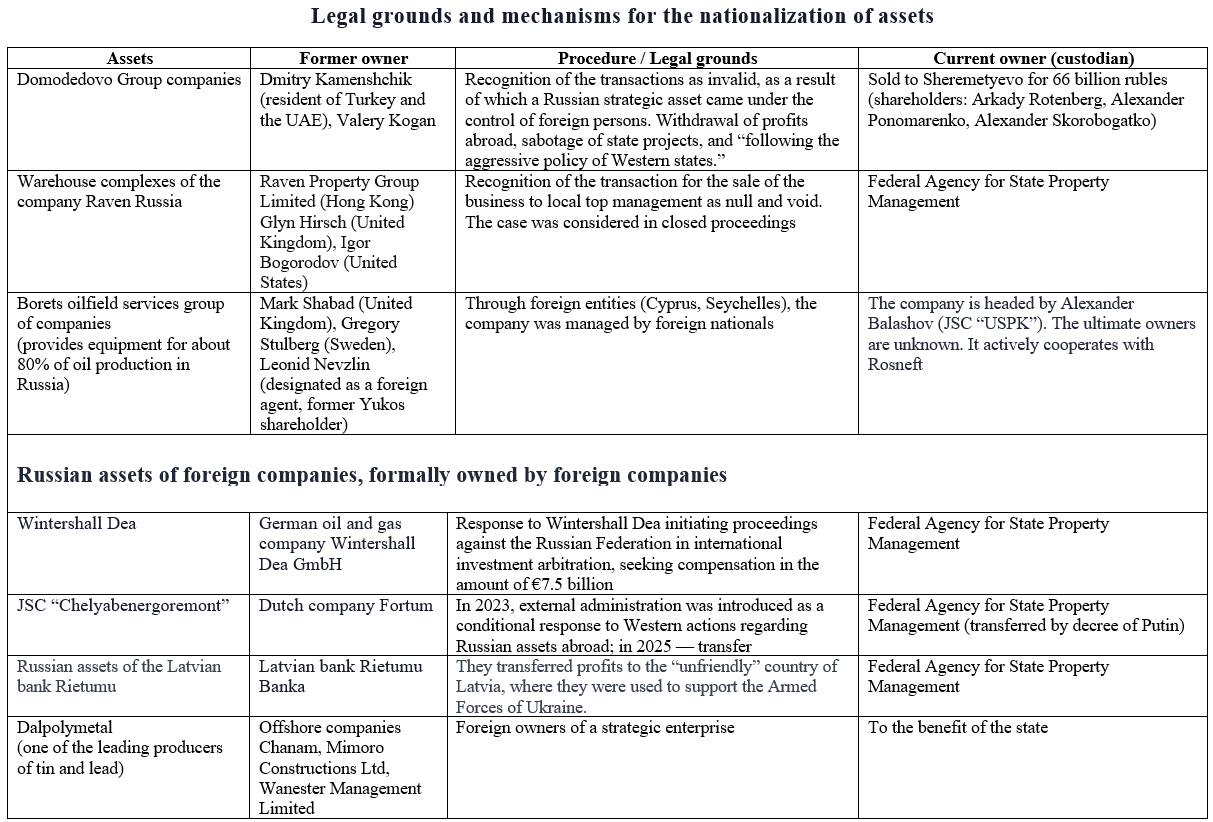
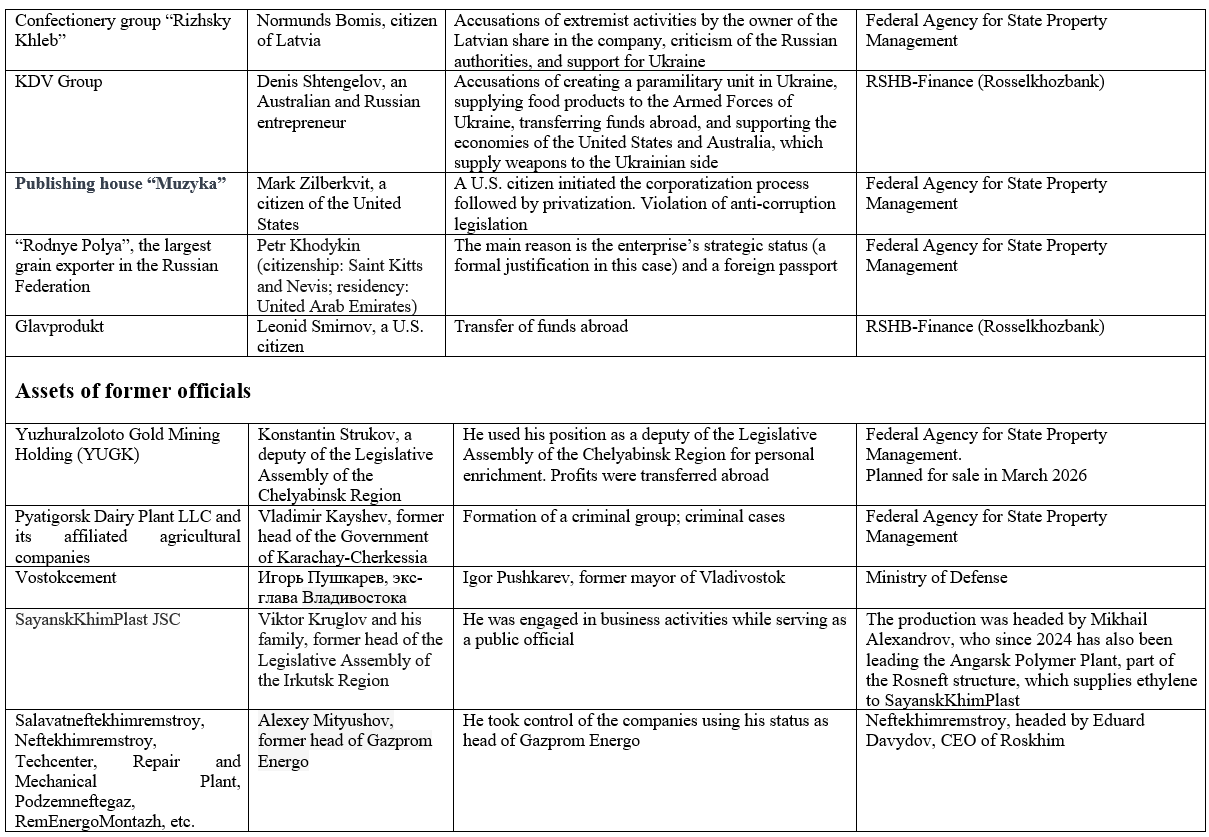
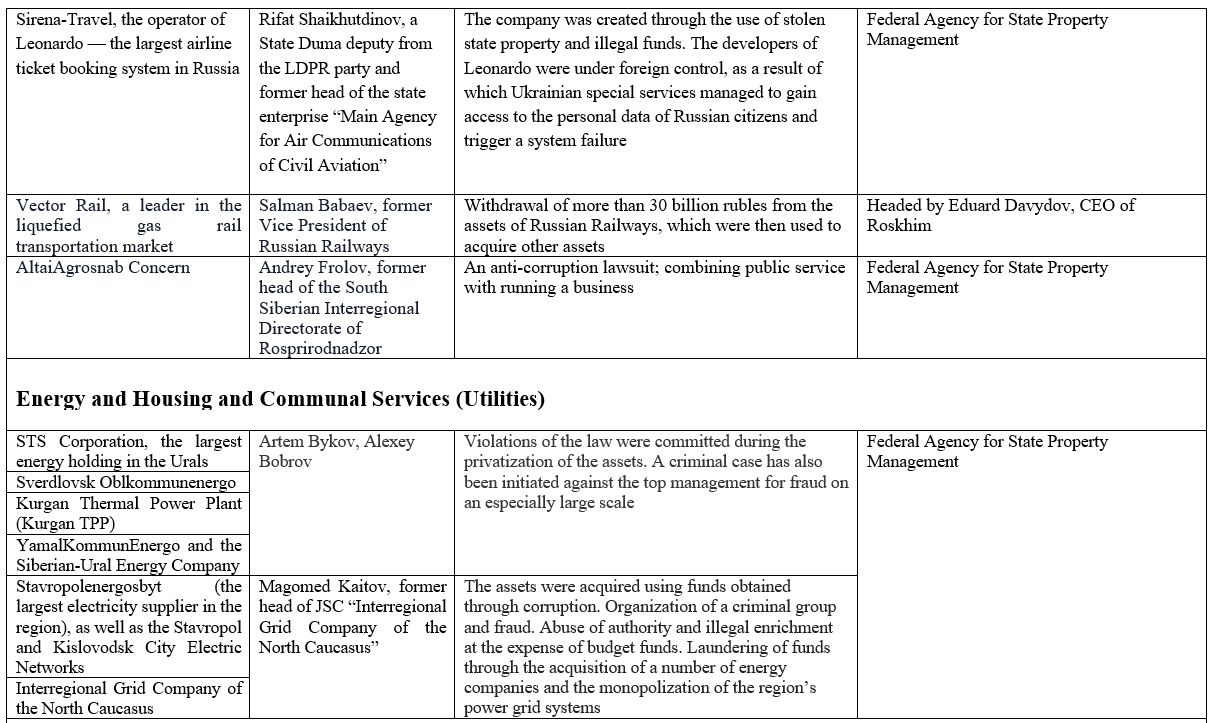
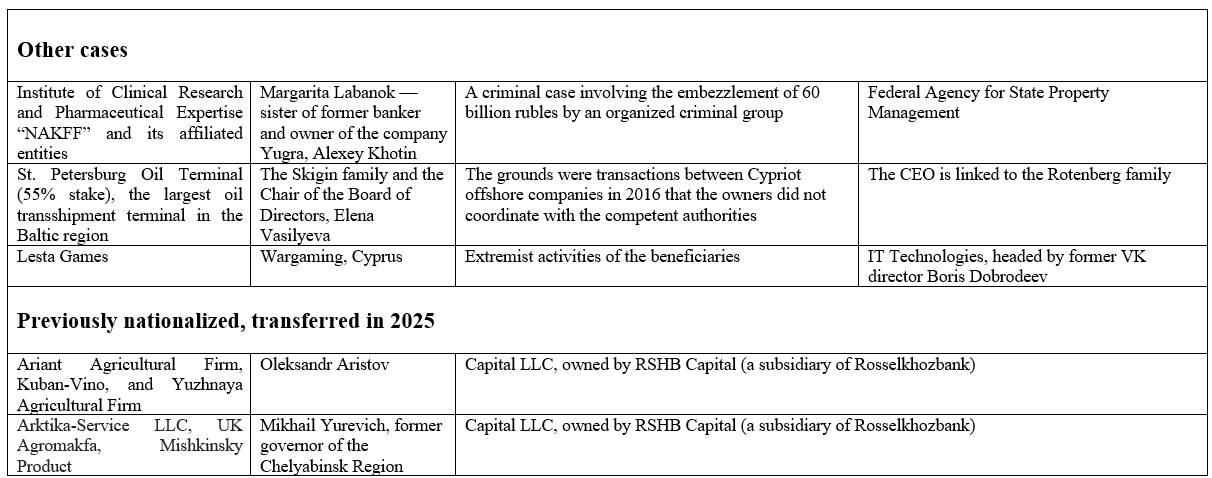
As can be seen, nationalization continues to expand, affecting ever more sectors — energy, housing and utilities, and IT— while the beneficiaries largely remain the same: Rosneft; structures linked to Patrushev (Rosselkhozbank); Kiriyenko (VK); the Rotenberg brothers (Roskhim); and Chemezov (Rostec).
A separate trend worth highlighting is the nationalization of ports. In 2025, four ports were nationalized, two of which were transferred to structures affiliated with Rosatom. In previous years, several other nationalized assets had already been transferred or sold to entities connected with Rosatom:
- Kaliningrad Sea Port — a universal maritime terminal handling containers, ferrous and non-ferrous metals, timber, grain, and bulk cargo. The port was nationalized in 2023, and two years later its assets were acquired by the FESCO Group, which is now associated with Rosatom.
- FESCO — one of Russia’s largest logistics companies operating across the Pacific, Atlantic, and Arctic Oceans. In 2023, the company was also nationalized, and by decree of Vladimir Putin 92.4% of its shares were transferred to Rosatom. FESCO operates terminal complexes in Novosibirsk, Khabarovsk, Tomsk, and Vladivostok. In 2025, FESCO acquired City Group JSC, the tenant of a terminal at the Kaliningrad Sea Fishing Port, located next to the Kaliningrad Sea Port. As a result, Rosatom consolidated the largest port assets in Kaliningrad.
- Vladivostok Commercial Sea Port, which had been part of the FESCO Group’s assets, was nationalized and transferred to Rosatom by presidential decision in 2023.
- Rosatom’s Hydrographic Enterprise also operates the ports of Pevek, Tiksi, Khatanga, Dikson, Dudinka, and Sabetta, where Rosatom provides vessel servicing and navigation functions. It is also the operator of a project for the construction and operation of a port fleet for LNG operations (FSUE Hydrographic Enterprise). These ports constitute a major portion of the Northern Sea Route’s port infrastructure.
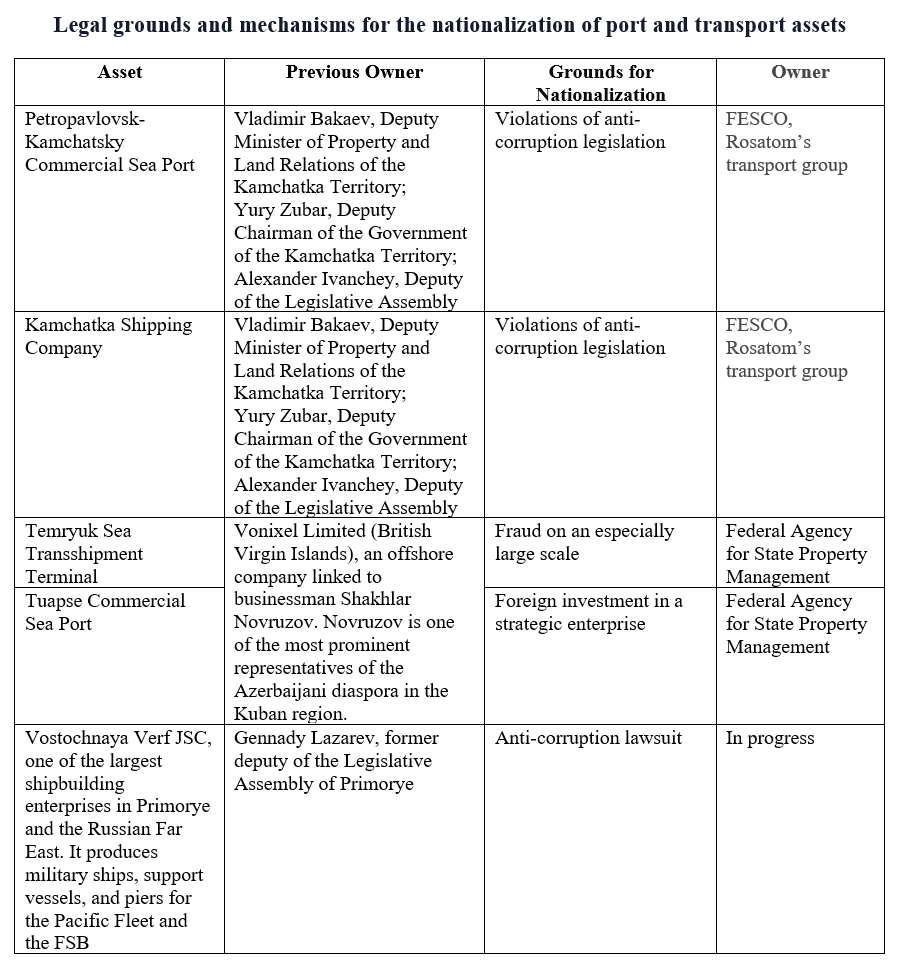
In addition to nationalization processes, other maritime logistics facilities are also being transferred to regional authorities. For example, in 2025 Rosimushchestvo transferred two piers to the Murmansk region for the construction of a ship-repair complex. This indicates that the development of logistical chains and supporting infrastructure for the Northern Sea Route continues.
Nationalization Trends in 2025–2026
Decentralization of nationalization: the process moves to the regions
Regional elites that lack strong connections in Moscow are increasingly becoming targets of nationalization. This process can be divided into several directions:
1. Expansion of nationalization targeting former officials
Previously, the process mainly affected officials who had been outside the power system for a long time. Now it increasingly targets the assets of recently departed officials, for example during changes of regional leadership.
The number of former officials falling under such investigations has also grown due to the inclusion of judges, former police chiefs, and other officials. The rise in cases involving the nationalization of judges’ assets coincided with the appointment of one of the key actors in nationalization processes—former Prosecutor General Viktor Krasnov—as Chairman of the Supreme Court.
Notable examples include: the case against Viktor Momotov, Supreme Court judge and Chairman of the Council of Judges, the case against Aslan Trakhov, former Chairman of the Supreme Court of the Republic of Adygea, the seizure of assets belonging to Alexander Chernov, former Chairman of the Krasnodar Regional Court.
2. Attacks on "white" (formally legitimate) businesses
An example is Sverdlovsk Oblkommunenergo. The court proceedings were held, as usual, behind closed doors following a lawsuit filed by the Prosecutor General’s Office.
The official accusations concerned the privatization of municipal infrastructure facilities and the withdrawal of funds disguised as tariff revenues.
However, the unofficial reason appears to have been a change of regional governor, who had previously supported this business.
Expansion of nationalization into previously untouchable sectors, including IT
Whereas earlier nationalization primarily affected the industrial, food, and logistics sectors, it is now increasingly targeting energy, housing and utilities, and IT. For example, in May last year, after the nationalization of Lesta (publisher of the games World of Tanks and World of Warships), four of Russia’s largest software industry associations sent a letter to Vladimir Putin warning that the forced nationalization of a private IT company would "undermine trust in the legal system and private property in the Russian Federation."
They argued that such actions could lead to capital flight, the departure of specialists, and a loss of entrepreneurs. Evidently, the letter had no effect. Processes of this kind in a sector officially designated as strategic for Russia may reflect both a shrinking pool of assets available for nationalization and growing difficulties in covering the financial losses of the state budget and Putin’s inner circle.
Absence of any statute of limitations despite business appeals
Despite repeated requests from the business community, no clear limitation periods have been introduced. For example, the Lazurny Bereg sanatorium in Gelendzhik, which had been privatized in 1992, was nevertheless nationalized decades later.
Transfer of property to the Ministry of Defense (nationalization in the interests of the MoD)
According to observations, most nationalized assets—even those in the defense sector—previously ended up within the structures of state corporations, such as Rostec, headed by Sergey Chemezov. In 2025, however, several examples appeared where assets were transferred directly to the Ministry of Defense.
This suggests that meeting the needs of the ministry through budget allocations and other funding sources has become increasingly difficult. Nationalization is thus becoming a way to compensate not only for the losses of Putin’s inner circle but also for the broader costs of the war against Ukraine.
Expropriation of assets from state corporations
Another emerging trend is the reallocation of assets belonging to state corporations. An example is the Khabarovsk Shipbuilding Plant. In 2025, 8.8 million out of 16.9 million shares of the plant held by the United Shipbuilding Corporation were transferred. The buyer was a structure affiliated with the Industrial Development Fund of the Khabarovsk Territory, with the transaction approved by the Russian Ministry of Industry and Trade.
Emergence of new grounds and mechanisms for nationalization
New justifications and formats for nationalization are also appearing. One example is the notion of a "voluntary" transfer. In August 2025, during the 35th anniversary of the company Volga-Dnepr, one of Russia’s largest cargo airlines, its founder Alexey Isaykin stated: "If the Motherland says that the company must go into service for the Motherland, then that’s it — nationalization, confiscation, a fair deal, any form is possible."
Prior to this statement, searches had been conducted at the company, and its head had been summoned to the Investigative Committee. Sources indicated that the Committee’s interest was related to an "audit of the airline’s economic condition." However, the primary reason may have been the company’s aircraft fleet and the interest of the Ministry of Defense in gaining access to it.
The deterioration of the economic situation is also creating new grounds for nationalization. For example, the Sverdlovsk Arbitration Court nationalized the property of the Turinsk Pulp and Paper Mill due to tax arrears.
Nationalization based on effectively fictitious accusations
In some cases, nationalization appears to rely on formal or weakly substantiated accusations. For instance, in the case involving the nationalization of the Pechatnya printing house, the Prosecutor General’s Office of the Russian Federation claimed that "the former owners of the company, being residents of the United Kingdom," attempted to conceal their ownership and allegedly planned to withdraw assets abroad "to the detriment of Russia’s national security," and then use them to support the military-economic potential of unfriendly countries.
However, an earlier criminal investigation by the Ministry of Internal Affairs regarding the allegedly fictitious sale of the asset in 2016 by a UK citizen and the supposed illegal transfer of funds abroad had been closed due to the absence of a crime. Over the course of a year, investigators failed to prove that the company’s director knew about the seller’s British citizenship or acted with the intention of circumventing currency restrictions. Formally, the transaction complied with existing legislation.
Despite this, the prosecutor’s office is attempting to secure the confiscation of the asset through a civil lawsuit, creating the impression that formal sanctions-related arguments are being used to redistribute a profitable business without sufficient evidence, with signs that the accusations may be legally artificial.
Prospects for the redistribution of property in the occupied territories
In our view, a large-scale redistribution of property in the occupied territories is likely in the near future.
On 16 December 2025, Vladimir Putin signed a law on the nationalization of ownerless property in the occupied territories and its transfer to the newly established authorities. While local administrations are responsible for the disposal of residential property, other types of assets—such as subsoil resources—must be coordinated with the federal authorities.
On 12 February 2026, Putin met with Vadim Yakovenko, head of the Federal Agency for State Property Management (Rosimushchestvo). During the meeting, Yakovenko not only reported on the results of nationalization and the replenishment of the budget—1.5 trillion rubles in 2023–2025—but also received a public instruction from Putin to complete the delineation of property in the "new regions" in 2026.
The president instructed Rosimushchestvo to provide maximum assistance to the authorities of the so-called "LPR/DPR" as well as the occupation administrations of the Zaporizhzhia and Kherson regions in this process.
Two weeks later, the head of the so-called "LPR," Leonid Pasechnik, stated that enterprises and commercial premises in municipalities require nationalization. According to Pasechnik, this would help bring these entities to break-even operation.
The so-called nationalization in the occupied territories has in fact been taking place since the first days of occupation, although previously it was chaotic and localized. For example, in 2025 alone, 93 real estate objects in the Zaporizhzhia region were classified as "ownerless" after property documentation checks were conducted. One of the key criteria in these checks was the presence of a Russian passport held by the owner.
The adoption of the relevant legislation and the directive to the head of Rosimushchestvo to complete the delineation of property rights suggest that the federal authorities are moving toward a systematic nationalization process in the newly occupied territories. This may be driven both by the shrinking pool of assets available for nationalization within Russia itself and by the desire to bring previously chaotic regional processes under centralized control.
Author: Olha Ivaniuk, PhD in Economics


